Why Chatbots Are the Wrong Interface for Customer Experience, and What Neuto AI Does Differently
Vinay Roy
Introduction
Most CX chatbots are optimized for turn-taking, not problem-solving. They are built to sustain dialogue, deflect tickets, and route users into existing workflows. That is not the same as resolving customer intent end-to-end.
Table of Contents
Key Takeaways
Why Chatbots Are the Wrong Interface for Customer Experience, and What Neuto AI Does Differently
From “talk to a bot” to “get to the outcome”: an architecture for resolution, not conversation
Most CX chatbots are optimized for turn-taking, not problem-solving. They are built to sustain dialogue, deflect tickets, and route users into existing workflows. That is not the same as resolving customer intent end-to-end.
This blog makes a technical and product argument: conversation is a poor primary interface for CX because customers do not want a chat, they want an outcome. Then it outlines what Neuto AI does differently: shift from conversational UX to outcome orchestration, where the interface is adaptive and the system is accountable to resolution, latency, and correctness.
1) The fundamental mismatch: conversation is not a task model
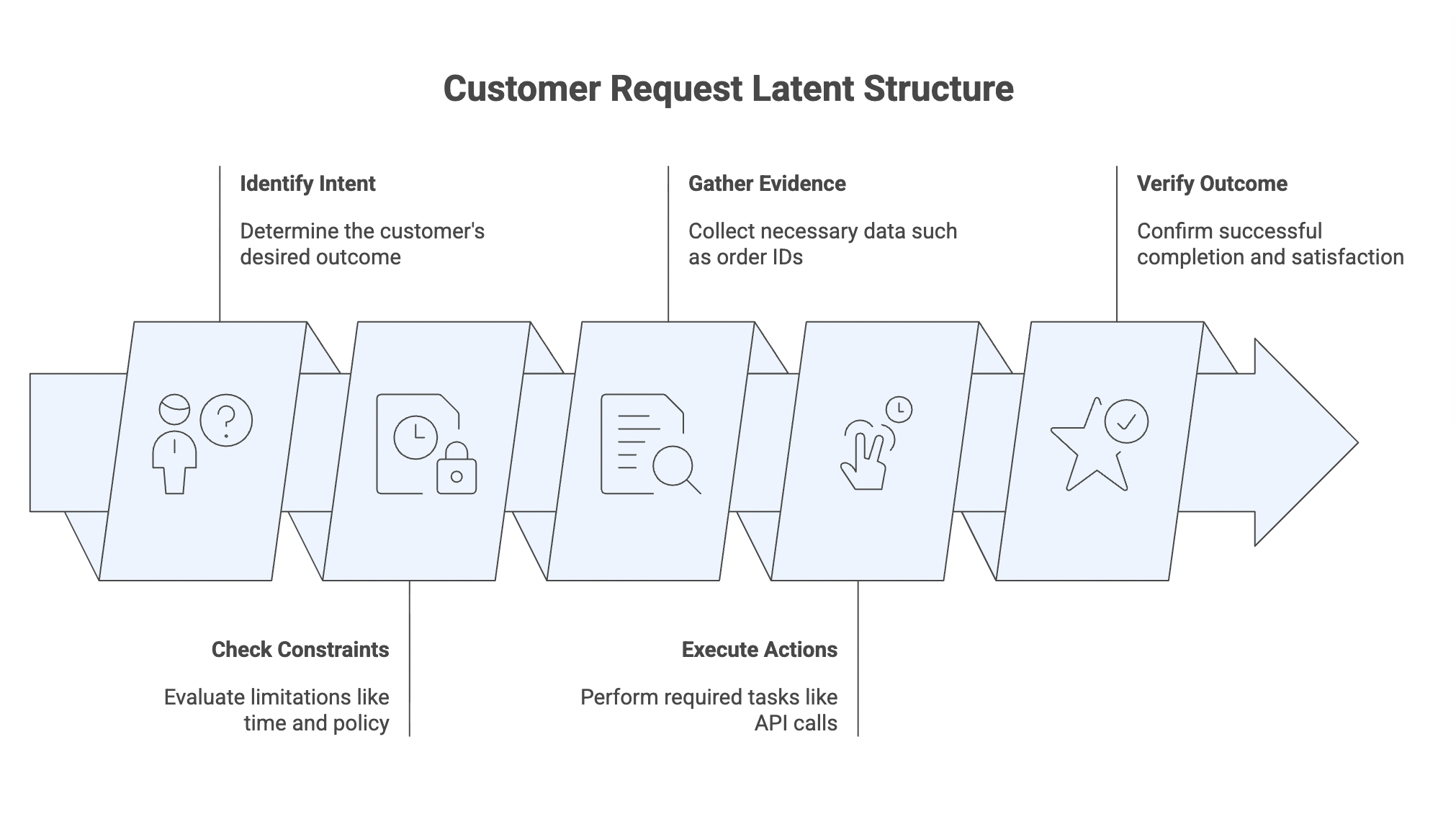
A customer request usually has a latent structure:
Intent: what outcome they want (refund, change address, troubleshoot device)
Constraints: time window, policy rules, eligibility, account state
Evidence: order IDs, logs, screenshots, error codes, usage history
Actions: API calls, workflow steps, approvals, notifications
Verification: confirm state transitions and customer satisfaction
A chatbot interface collapses all of that into a linear sequence of text turns.
Why this fails in practice
High entropy input, low tolerance for friction Customers often arrive frustrated. They do not want to “describe the problem in natural language” multiple times. They want the system to infer context from their account state and ask only for missing evidence.
Conversation forces serial execution Many tasks are parallelizable: verify identity, check policy eligibility, fetch order details, detect known incident, assess next best action. Chatbots do it sequentially, which increases latency and abandonment.
Dialogue is ambiguous, but operations require determinism CX workflows depend on precise state. A single misunderstood entity (order ID, product variant, subscription tier) causes incorrect actions. Chatbots are probabilistic, while operations are transactional.
The interface over-collects or under-collects information
Over-collect: users get long questionnaires even when the system already has the data.
Under-collect: the bot proceeds without required evidence, then fails downstream.
The result is a system that can talk, but cannot reliably complete.
2) The hidden technical debt of chatbot-first CX
Chatbots often look like “LLM + prompt + knowledge base.” That architecture has predictable failure modes when deployed in production CX.
A) Retrieval is not resolution
RAG improves factuality, but CX is dominated by operations:
“Cancel my subscription effective end of billing cycle.”
“Replace this item, but I need it delivered before Friday.”
RAG answers questions; it does not complete transactions.
B) The “LLM as router” anti-pattern
Many chatbots use the LLM to decide which department or macro to route to. That creates:
inconsistent routing under distribution shift
fragile prompt logic that breaks on edge cases
no calibrated confidence to trigger escalation
poor observability (why did it choose that path)
Routing should be a measurable decision system, not a vibe.
C) No explicit notion of “done”
A chatbot’s objective is typically user engagement metrics:
containment rate
deflection
average handle time
CSAT on the bot interaction
But “successful conversation” does not equal “resolved issue.” Without an explicit completion criterion, the system optimizes for plausible responses, not verified outcomes.
D) Tool use increases capability, and risk
When bots are given tools (refund API, address change, password reset), the core question becomes:
Under what conditions is it safe to act?
How do we prevent incorrect or unauthorized actions?
How do we guarantee auditability and policy compliance?
Most chatbot stacks bolt on tool calls without a robust control plane.
3) CX is a control system, not a chat experience
If you model CX correctly, it looks less like a chatbot and more like a control loop:
Observe: gather context and evidence
Decide: select a resolution plan
Act: execute steps via tools and workflows
Verify: check state transitions and user confirmation
Learn: update policies, classifiers, and playbooks based on outcomes
This framing suggests a different primary interface:
customers should see progress, options, and confirmation
the system should ask targeted questions only when required
the system should surface “why” and “what happens next”
the system should be accountable to resolution KPIs
Text chat can exist, but it should be a fallback, not the core.
4) What Neuto AI does differently: outcome orchestration over conversation
Neuto AI is built on a simple thesis: customers want the fastest path to the correct outcome, and CX teams need systems that are measurable, safe, and maintainable.
4.1 Interface: adaptive resolution UI instead of chat-only
Rather than forcing everything through text, Neuto AI uses an interface that can dynamically switch between:
structured inputs (order selection, dropdown reasons, time slots)
guided flows (step-by-step troubleshooting)
quick actions (refund to original payment method)
transparent status (refund initiated, ETA, reference ID)
targeted clarification (one question at a time, only when needed)
This reduces entropy and increases completion.
Product impact
fewer turns per resolution
less customer effort
lower abandonment
lower recontact rate
4.2 Architecture: plans, tools, and verification
Neuto AI treats each case as a resolution plan that is executed and verified.
A typical pipeline:
Intent and entity extraction Identify intent(s), entities, and urgency. Extract order IDs, device models, locations, dates.
Context assembly Pull customer state: account tier, order history, delivery status, previous tickets, known incidents.
Policy and eligibility evaluation Encode business rules and constraints explicitly. Separate “what is allowed” from “how to say it.”
Resolution planning Choose a playbook: refund, replacement, troubleshooting, escalation. Plan is structured and inspectable.
Tool execution with guardrails API calls and workflow steps happen through a controlled execution layer that enforces:
permissions
rate limits
required fields
idempotency
safe defaults
rollback where possible
Verification and customer confirmation Confirm state changes with system-of-record reads, not just “I did it.” Provide receipts and next steps.
human-in-the-loop for sensitive actions or low-confidence cases
4.4 Observability: measure the system like a production service
Neuto AI instruments CX like an engineering system:
resolution rate by intent
time-to-resolution distribution (p50, p95)
recontact rate
escalation reasons
tool failure rates and retries
policy conflict frequency
hallucination and incorrect-action near misses
This enables continuous improvement without prompt whack-a-mole.
5) A concrete example: “Where is my order?” vs “Fix my delivery”
A classic chatbot handles “WISMO” like this:
Customer: “Where is my order?”
Bot: “Please provide your order number.”
Customer provides it.
Bot retrieves tracking.
Bot pastes tracking info.
Customer: “It’s wrong. I moved. Can you reroute it?”
Bot fails or escalates.
This is a conversation-first workflow.
Neuto AI treats it as a resolution-first workflow:
Detect the intent: delivery status and potential delivery exception.
Pull the order record and shipment state.
Determine available actions based on carrier stage:
before label created: update address in OMS
in transit: carrier hold request if supported
out for delivery: limited options, schedule redelivery or initiate replacement
Present options in UI with constraints:
“Hold at carrier location (available)”
“Reroute (not available after in-transit stage)”
“Replace item (available, arrives by X)”
Execute the selected action with verification and confirmation.
The customer experience is not “chatting with a bot.” It is completing a task quickly with clarity and control.
6) Why this matters for CX leaders: metrics that move
Chatbot-first programs often plateau because they optimize containment, not outcomes. Outcome orchestration targets the metrics that matter:
First Contact Resolution (FCR) increases because the system can actually act.
Cost per contact decreases because fewer cases bounce to agents.
Customer Effort Score improves because inputs are structured and contextual.
Compliance risk drops because actions are governed and auditable.
Agent productivity increases because escalations arrive with context, evidence, and suggested next steps.
7) The practical migration path
Neuto AI does not require ripping out your existing CX stack. The usual deployment path:
Start with the highest-volume intents (WISMO, returns, subscription changes).
Integrate read-only context first to reduce friction.
Add tool execution for low-risk actions with clear verification.
Expand policy coverage and edge cases.
Use observability data to harden and scale.
Closing: the interface should match the job
Conversation is a convenient fallback. It is not a scalable primary interface for customer experience because CX is fundamentally an operational resolution problem.
Neuto AI is built to resolve, not chat: an outcome-driven interface, a structured planning and execution layer, verifiable tool use, and production-grade observability. That is how you move from “a bot that talks” to “a system that delivers outcomes.”
About the author:
Vinay Roy
Fractional AI / ML Strategist | ex-CPO | ex-Nvidia | ex-Apple | UC Berkeley
Subscribe to our newsletter
Subscribe our newsletter to get the latest news and updates!







.webp)