
Over the past two years, enterprises have adopted AI at an unprecedented pace. Content generators, copilots, agents, and automation tools now exist for nearly every function. Slides are created faster. Responses are drafted instantly. Reports appear on demand.
Yet for most organizations, the promised outcomes have not materialized.
Margins have not meaningfully expanded.
Cycle times have not collapsed.
Operational risk has not declined in proportion to spend.
This gap exists because most business problems are not asset-production problems. They are orchestration problems.
AI tools are very good at producing things. Businesses, however, are systems.
An asset is a local output. A slide. A blog post. A customer reply. An analysis.
An outcome is the result of many assets moving through a system under constraints.
From a systems perspective, optimizing asset creation improves node efficiency. Outcomes, however, are governed by edges: handoffs, dependencies, queues, approvals, exceptions, and feedback loops.
This distinction matters.
Most AI tools optimize nodes. They make a single step faster or cheaper. Very few address the structure of the workflow itself.
As a result, organizations improve local throughput while global performance remains bounded.
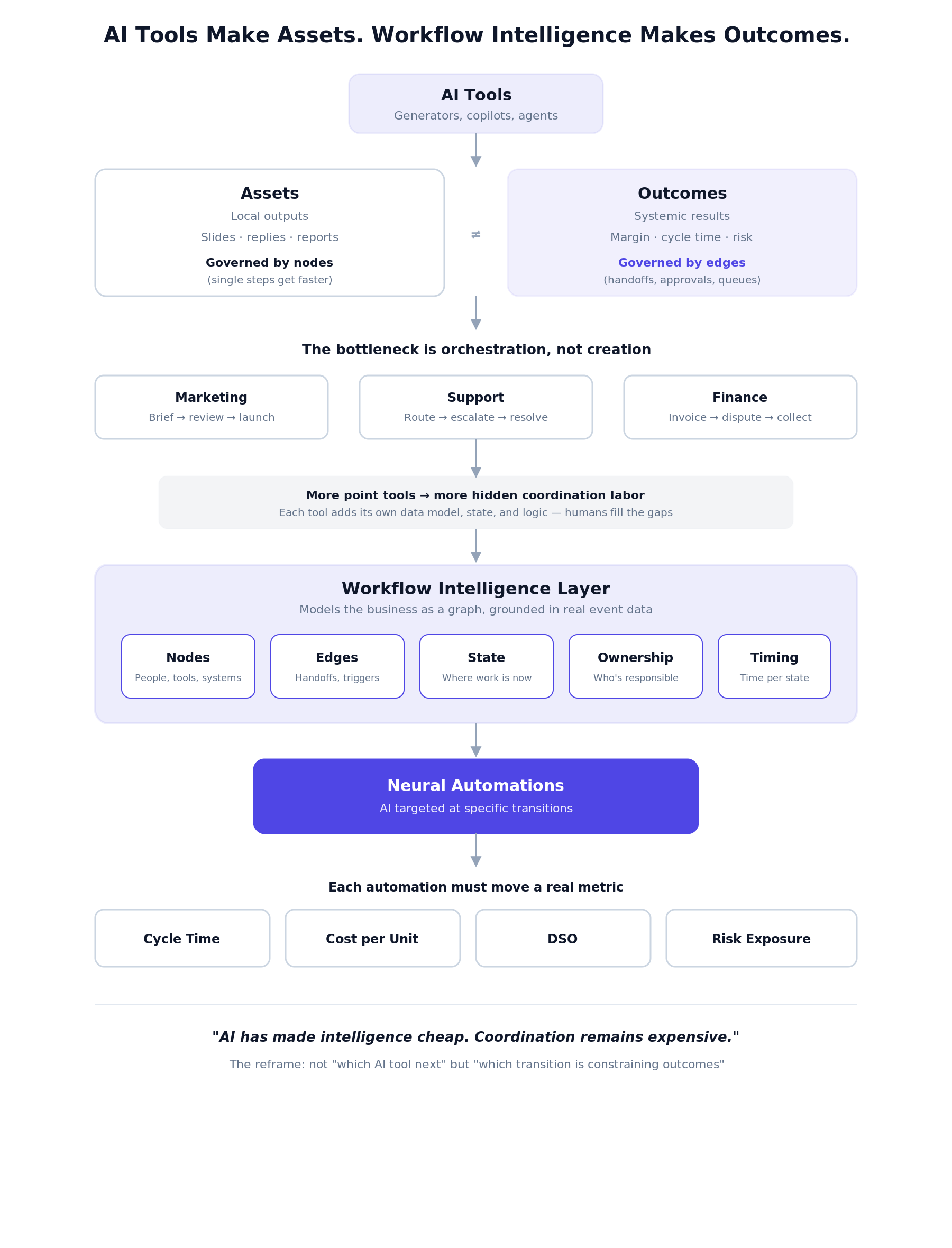
Consider how work actually flows in core functions.
Marketing is not the act of generating a slide or an ad. It is an end-to-end system:
Strategy → brief → creation → review → legal → localization → launch → measurement → iteration
Each transition crosses tools, people, and incentives. Delays are rarely caused by asset creation. They are caused by:
AI tools accelerate individual tasks but do not coordinate the system. The bottleneck moves, but it does not disappear.
Support is not drafting an answer. It is:
The cost structure is dominated by misrouted tickets, repeated handoffs, and delayed escalation. A drafting assistant improves response quality but does not materially change throughput unless the workflow itself is redesigned.
Finance is not issuing an invoice. It is managing state over time:
Delays come from fragmented ownership, unclear state transitions, and manual exception handling. Faster invoice generation does not reduce DSO if the orchestration remains unchanged.
Across functions, the pattern is the same. Outcomes are constrained by coordination, not creation.
From a technology leadership perspective, this creates a paradox.
Each AI tool improves a local metric.
The system as a whole becomes harder to operate.
Every new tool introduces:
None of them fully understand what happens before or after their scope.
Humans fill the gaps.
They reconcile state across systems. They move information manually. They monitor exceptions. They perform what is effectively orchestration labor.
This hidden labor does not disappear with AI. It increases as tool sprawl increases.
The result is a system that is locally optimized and globally inefficient.
What is missing is not another AI tool, but a workflow intelligence layer.
Workflow intelligence answers questions that individual tools cannot:
This requires modeling the business as a graph, not as a set of applications.
At a minimum, a workflow intelligence layer models:
Critically, this model must be grounded in real event data, not documented processes. The difference between “how work is supposed to happen” and “how it actually happens” is where most inefficiency lives.
Mapping alone does not create value. Automation without mapping creates noise.
The leverage comes from using workflow intelligence to decide:
This produces what Neuto refers to as Neural Automations: AI-powered workflows that live on the edges between systems, not inside a single tool.
Examples include:
Each automation is explicitly tied to a business metric: cycle time, cost per unit, DSO, conversion rate, or risk exposure.
If an automation does not move a metric, it does not ship.
For CTOs and CIOs, workflow intelligence provides architectural leverage. Instead of integrating tools pairwise, the organization gains a system-level view that can survive tool churn and vendor changes.
For CFOs, it creates accountability. AI spend can be traced to outcomes, not activity. Efficiency gains are measurable at the system level, not inferred from adoption metrics.
Most importantly, it changes the question being asked.
Not “What AI tool should we buy next?”
But “Which workflow transition is constraining our outcomes, and why?”
AI has made intelligence cheap.
Coordination remains expensive.
Until intelligence is embedded into how work moves through an organization, faster asset creation will not translate into better outcomes.
AI tools will continue to make things.
Workflow intelligence is what makes those things matter.
That is the difference between local efficiency and systemic impact.





.webp)